Powdered sugar coffee usually means a sweetened instant coffee drink where fine sugar dissolves quickly, especially for busy people who want convenience without grittiness. Powdered coffee formats are commercially significant, with the global coffee powder market estimated at USD 45.2 billion in 2024 and projected to reach USD 67.8 billion by 2033, according to market research cited by Café do Brasil.
You're standing in an office kitchen with one hand on a travel mug, or at a campsite trying to make coffee before the wind picks up. The water is hot, the instant coffee is ready, and granulated sugar sits at the bottom of the cup refusing to disappear. Powdered sugar looks like an easy fix. Sometimes it is. Sometimes the fine powder brings along starch, clumps, or a thicker mouthfeel that doesn't belong in a clean cup.
The useful question isn't whether powdered sugar can go into coffee. It can. The better question is when its fast dissolution is worth the texture compromise, and when regular sugar gives you a cleaner result.
What Powdered Sugar Coffee Really Means
At a practical level, powdered sugar coffee isn't one rigid recipe. It's a broad description for coffee sweetened with confectioners' sugar, icing sugar, or another finely milled sugar, often in an instant coffee preparation. A commuter may stir it into a mug at work. A camper may pack it because it mixes quickly. A home barista may use it in a cold or whipped coffee where ordinary crystals take too long to dissolve.
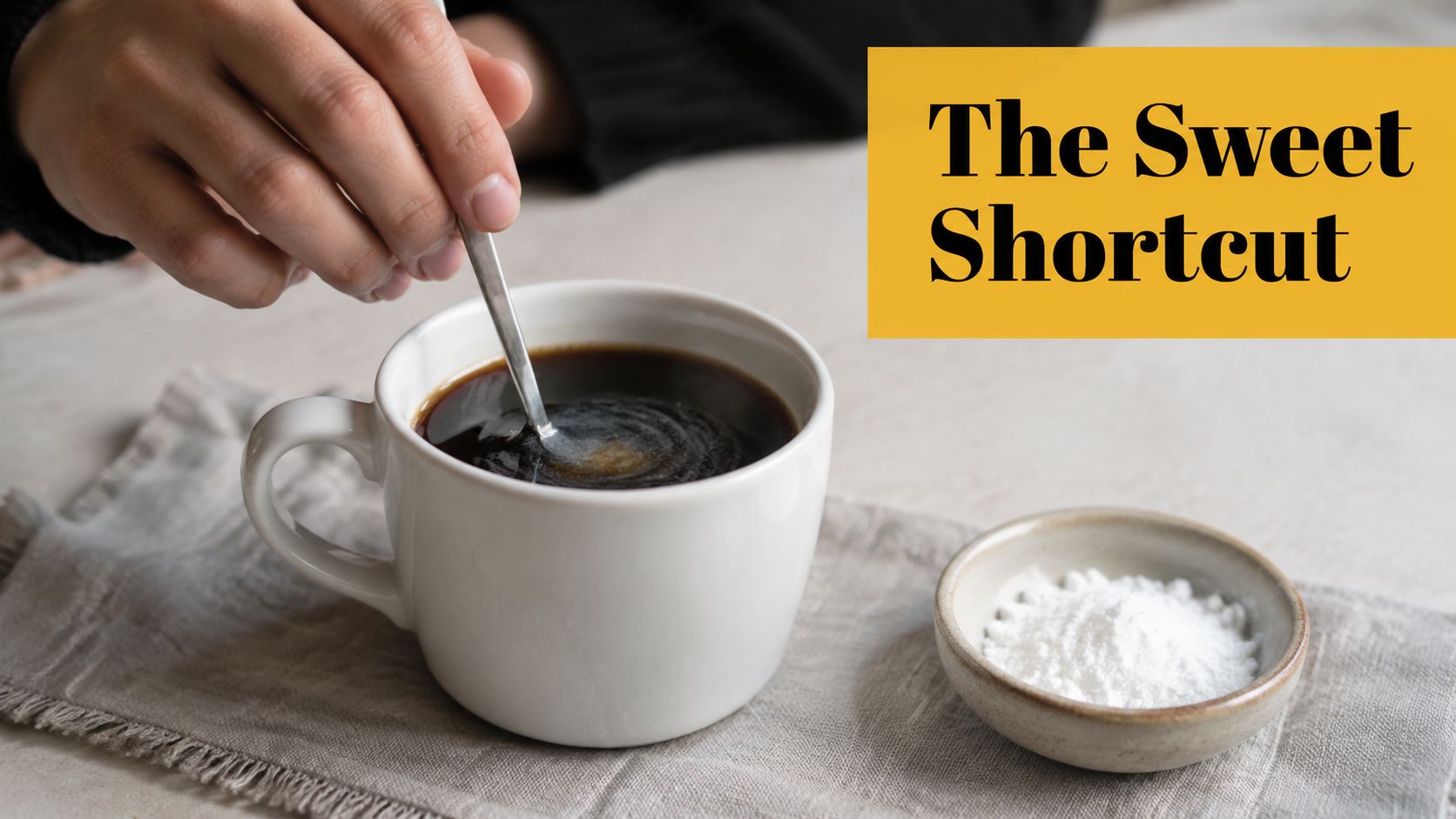
The phrase also appears because powdered coffee and powdered sweeteners share the same convenience culture. Instant coffee was patented by David Strang in 1890, and mass production began in 1938, according to the history of instant coffee from Café do Brasil. A powdered coffee base travels well, stores easily, and dissolves with little equipment. Fine sugar fits that same routine, particularly when you're making a drink with a kettle, a mug, and a spoon.
It's a method, not a traditional coffee style
Sweetened coffee has much older roots than instant coffee. CoffeeReview records that early coffee drinkers in the Arabian Peninsula drank it black, while Egyptians are credited with adding sugar around 1625. The source describes a traditional Middle Eastern method in which powdered coffee is boiled with sugar to create a syrupy drink, as explained in CoffeeReview's history of milk and sugar in coffee.
That history matters because it separates two ideas that people often blend together. Powdered sugar coffee can refer to a modern convenience shortcut, but sweet coffee itself has been adapted across cultures for centuries. If you're deciding what to add to your morning cup, you don't need to treat the phrase as the name of a single official beverage.
For a wider look at practical coffee additions, see what you might put in your coffee. The choice comes down to the drink in front of you. In hot instant coffee, powdered sugar can save stirring time. In a carefully brewed cup, it may hide flavors you'd rather taste. In iced coffee, it can offer speed, but only if you manage clumping and starch.
Practical rule: Choose powdered sugar for fast mixing first, sweetness second. If texture and flavor clarity lead your priorities, test regular sugar before making the switch.
How Powdered Sugar Changes Coffee Flavor and Texture
At a busy office desk, a short spoon and cooling instant coffee leave little time for slow stirring. Powdered sugar usually disperses faster than larger crystals, but its real trade-off is less obvious: the drink may lose crystal grit while gaining fine suspended material, starch, or body.
Sugar changes more than sweetness. Chemistry research describes sugars as selective hydrotropes. In coffee solutions, they can increase caffeine in its monomeric state while decreasing oligomeric forms, affecting the balance of flavor-active compounds and reducing perceived bitterness, according to research published by the American Chemical Society.
That helps explain why a sweetened cup can taste less harsh even when the coffee itself remains unchanged. Sugar can influence how compounds behave in solution, giving drink makers room to adjust sweetness, strength, temperature, and bitterness separately.
Why fine particles mix quickly
Particle size creates the first practical difference. Powdered sugar exposes more surface area than coarse crystals, so hot liquid contacts more of it at once. Guidance on sugar dissolution in liquids identifies temperature and agitation as major factors, while finer particles increase contact and speed the movement of soluble material into the drink.
In hot instant coffee, that often means less waiting and less sugar settling at the bottom. It suits a short office spoon, a paper cup, or limited water on a camping trip. The benefit is clearer when the drink cools before mixing is complete.
The hidden ingredient problem
Powdered sugar often contains more than sugar. Cornstarch is commonly added to limit clumping during storage. In a quick hot drink, it may go unnoticed, but poor dispersion can leave faint thickness, residue, or a pasty finish.
The brewing format changes the result:
- Hot instant coffee usually provides enough heat and movement for good dispersion.
- French press coffee can retain fine particles and starch because its filter does not remove every small suspended material.
- Espresso drinks may reveal the added body more clearly when sugar is stirred into a concentrated shot.
- Iced coffee is the hardest case. Cold liquid slows dissolution and encourages floating clumps.
Powdered sugar can remove crystal grit while adding starch-derived body. A drink may feel smooth in one sense, yet thicker or slightly cloudy in another. For quality-focused instant coffee habits, the shortcut works best when speed matters more than a perfectly clean finish. If filtration and clarity matter, sift the powder, stir it into a small amount of hot coffee first, or choose a sugar without added starch.
Powdered Sugar vs Granulated Sugar in Coffee
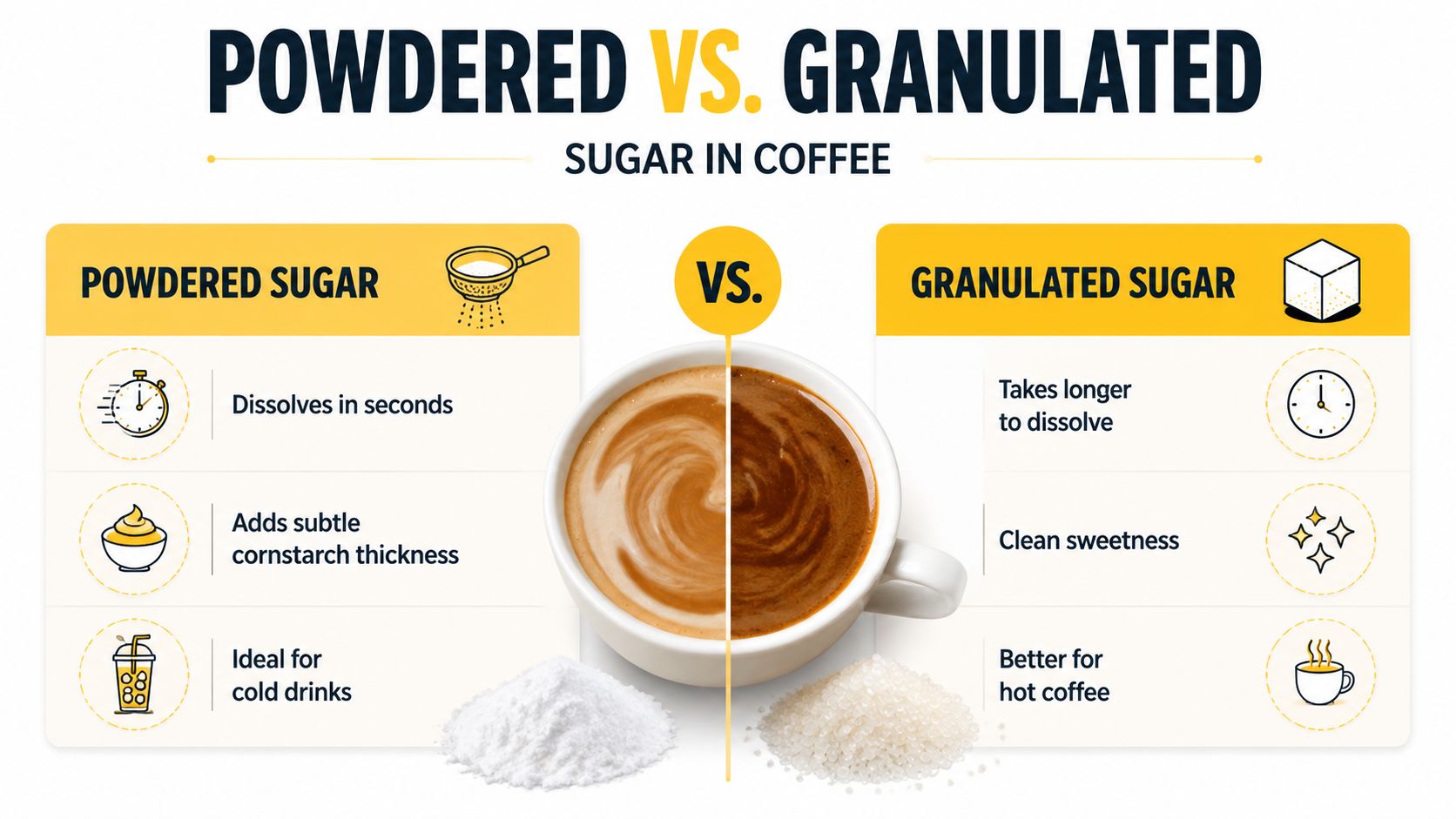
Powdered sugar favors speed. Granulated sugar favors a simpler ingredient list and a cleaner finish. The better choice depends on drink temperature, stirring time, and whether fine particles or added starch may affect the cup.
| Factor | Powdered Sugar | Granulated Sugar |
|---|---|---|
| Dissolution | Fine particles dissolve rapidly in hot liquid | Needs more agitation and time |
| Texture | May add slight body if cornstarch is present | Usually gives cleaner sweetness |
| Hot instant coffee | Convenient for quick mixing | Reliable when you can stir |
| Cold coffee | Can clump unless pre-dissolved | Also dissolves slowly, often requiring syrup |
| Filtered drinks | Fine material may pass through some filters | Less likely to affect filtration |
| Storage | Often resists clumping because of added starch | Can remain cleaner as a single ingredient |
Both products deliver sucrose. The meaningful contrast is how quickly the sugar enters the drink and what else enters with it. Powdered sugar exposes more surface area to the liquid, so it disperses quickly in a hot instant coffee. Granulated sugar keeps its larger crystal structure and needs more movement and time to dissolve.
Match the sugar to the coffee
At a desk, powdered sugar is practical when an instant coffee needs to be ready before the next task and undissolved crystals are unacceptable. On a camping trip, it works with limited equipment and a short stirring window. A sealed packet also avoids carrying syrup or waiting for a full boil after adding the sweetener.
That speed has a texture cost. Powdered sugar may contain cornstarch to reduce clumping, and the starch can add faint body or cloudiness. Fine particles may also pass through some filters, leaving more suspended material than granulated sugar. Granulated sugar is therefore the better fit for hot drip coffee when you have time to stir and want the coffee to finish as clearly as possible.
Alternative sweeteners require a separate test. Their sweetness, aftertaste, and dissolution can differ, so they are not automatic substitutes for either sugar format. Evaluate a new option in the drink you normally prepare, including its usual temperature and milk, rather than judging it in plain water.
Use powdered sugar for convenience. Use granulated sugar when a clean, uncluttered finish matters more than immediate mixing.
For iced coffee, neither dry form performs well when dropped straight into a cold drink. Dissolve the sugar in a small amount of hot water first, then add the coffee, cold water, and ice. This brief preparation usually improves dispersion and texture more than switching between the two dry sugar formats.
Quick Powdered Sugar Coffee Recipes and Uses
A hot mug is the most reliable place to use powdered sugar. Add instant coffee and sugar before the water, then stir as soon as the pour begins. Early agitation wets the fine particles before they collect on the surface or cling to the cup.
The fast hot mug
- Build the dry base. Add your preferred amount of instant coffee and a modest amount of powdered sugar to a clean mug.
- Make a small paste. Add a splash of hot water and stir until the coffee and sugar are evenly wet. This step limits dry pockets and helps reveal whether the sugar contains a starch that adds body.
- Fill the mug. Pour in the remaining hot water slowly while stirring. Scrape the bottom once, where residue often settles.
- Taste after mixing. Adjust the sweetness only after the coffee has dissolved. Sampling too early can lead to an overly sweet cup once the remaining powder disperses.
The method suits an office desk because the mug does all the mixing and no saucepan is needed. It also fits a camping setup with a compact kettle, especially when a short stirring window matters more than a perfectly clear finish.
A cold coffee version
Dry powdered sugar performs poorly when sprinkled over ice. The cold surface and limited movement encourage clumps, while any anti-clumping starch can leave the drink slightly cloudy or thick.
Dissolve the instant coffee and sugar in a small amount of hot water first. Add cold water and ice only after the concentrate looks smooth. Add milk afterward so you can judge both sweetness and texture before the drink becomes harder to assess.
A whipped instant drink
Instant coffee, sugar, and water can be shaken or whipped into a foamy drink. The frappe format is linked to a 1957 creation made with instant coffee, sugar, and water, then shaken into foam, as recorded in Café do Brasil's instant coffee history. Powdered sugar incorporates quickly, but cornstarch may give the foam a heavier mouthfeel and leave more suspended material.
For a chocolate version, mix the instant coffee, sugar, cocoa, and a little hot water into a smooth base before adding more liquid. Cartograph Coffee's guide to making an amazing mocha with instant coffee offers a practical reference for keeping that combination from turning gritty.
Keep powdered sugar in a dry, airtight container. Sift hardened lumps before mixing instead of trying to crush them in the mug.
When Powdered Sugar Is a Smart Shortcut
Powdered sugar earns its place when the main problem is time between pouring and drinking. In hot instant coffee, fine particles disperse quickly and reduce the chance of a gritty last sip. That's valuable during a rushed morning, a shift change, or a campsite breakfast where you don't want another piece of equipment on the table.
It's also practical in shared service settings. A café or office can mix sweetened powdered ingredients into a drink with fewer visible crystals, but the operator should still check the ingredient label. A starch-containing product behaves differently from sugar milled without an anti-clumping additive.
Where the shortcut helps
- Instant coffee packets: Fine sugar matches the powder-based format and dissolves with little stirring.
- Travel mugs: Short spoons and narrow openings make fast dispersion useful.
- Outdoor brewing: Less stirring reduces spills and cleanup around a stove or kettle.
- Foamy drinks: Powdered ingredients can incorporate quickly into a whipped base.
Temperature is the dividing line. Hot liquid and agitation support dissolution. Cold liquid, ice, and limited movement expose the weaknesses of the format.
The same logic applies to kettle habits. If you're preparing several drinks with different temperatures, Goveelife presets tea coffee can help you manage repeatable heating routines. The kettle won't solve starch or clumping, but consistent water temperature makes it easier to evaluate whether the sugar choice is improving the drink.
Here's a useful test: make the same instant coffee twice, once with powdered sugar and once with granulated sugar. Stir both for the same amount of time, then drink them as they cool. You'll notice whether speed, sweetness, and mouthfeel differ enough to matter in your routine.
Where it harms clarity
Powdered sugar is less attractive in French press coffee, espresso, and carefully filtered brews when the drinker values a transparent mouthfeel. Cornstarch can leave a slight coating, and fine particles may interact with the filter or remain suspended. That doesn't make the drink unsafe or unusable, but it can make the cup feel less precise.
Watch for three warning signs:
- A chalky or pasty finish after the sweetness has faded.
- Cloudiness that wasn't present with regular sugar.
- Lumps around the rim or bottom after the drink cools.
The video below shows the kind of quick preparation that makes powdered sugar appealing, particularly for instant coffee routines.
If those texture issues bother you, switch to granulated sugar for hot drinks or dissolve either sugar in a small amount of warm water before adding it to a cold beverage. The best shortcut is the one that removes work without creating a new quality problem.
Health Context for Sugar in Coffee
The health question is less about whether sugar is powdered or granulated and more about how much added sugar enters your overall diet. Milling changes particle size and mixing behavior, but it doesn't turn sucrose into a completely different sweetener. A spoonful of powdered sugar still belongs in the same broader conversation as other added sugar sources.
The evidence also doesn't support a simplistic rule that every sweetened coffee is automatically harmful. A Harvard summary discussed by Lose It reports that coffee with about a teaspoon of sugar may still be associated with health benefits, while larger added-sugar patterns across the day remain a more important concern. The same source discusses a 2023 study summary that found no statistically significant link between sugar added to coffee or tea and several major mortality or disease outcomes after adjustment.
That doesn't make sugar-free coffee mandatory, and it doesn't make unlimited sweetening sensible. It means your decision should account for the rest of the day, including sweetened drinks, desserts, breakfast foods, and flavored coffee products.
A practical way to judge your habit
Start with the amount you use, not the amount you think you use. Powdered sugar can disappear into coffee so quickly that it's easy to add more before tasting. Measure it once, then decide whether the sweetness improves the drink enough to justify keeping it in your routine.
A reasonable approach is to:
- Keep sweetness intentional. Add it to solve bitterness or improve enjoyment, not automatically.
- Taste before increasing. Let the coffee dissolve fully before adding another spoonful.
- Look at the whole day. One cup matters less in isolation than a repeated pattern of added sugar.
- Test unsweetened options occasionally. A better instant coffee may reduce the need for heavy sweetening.
If you're reducing added sugar, sugar-free sweeteners for coffee can help you compare alternatives based on taste and aftertaste rather than assuming one option suits every cup.
Coffee can also affect dental appearance, regardless of whether you sweeten it. For practical guidance on how to avoid coffee teeth stains, focus on consistent oral-care habits and follow advice suited to your dental needs.
The verdict is straightforward. Powdered sugar is a useful coffee ingredient, not a health loophole. It's most valuable when fast dissolution matters, especially in hot instant drinks. If you care more about a clean, unaltered texture, use granulated sugar or reduce sweetness altogether. For busy drinkers, the best routine combines a coffee that tastes good on its own, deliberate sweetening, and a mixing method that leaves no grit or starch behind.
Cartograph Coffee offers organic freeze-dried instant coffee packets made with one ingredient, coffee beans, for workdays, travel, camping, and home use. Visit Cartograph Coffee to explore a convenient instant coffee base and decide whether powdered sugar improves your own cup.