You're standing at the kitchen counter with a glass full of ice and a jar of instant coffee. You stir, wait, and stir again. Some of the powder dissolves; the rest floats, clumps, or settles at the bottom. The drink is cold, but it doesn't taste quite right.
That frustrating gap between "quick" and "enjoyable" is why the details matter. A good instant iced coffee mix depends not only on its flavor, but also on how its particles meet cold liquid, how you mix it, and how you store it. Once you understand those factors, you can choose a format for your routine and make a smoother cup at home, at work, or on a campsite.
The Morning That Made Me Rethink Instant Cold Coffee
At a campsite, coffee has to fit around everything else. You've packed the mugs, found water, and maybe you're trying to make breakfast while the tent is still half open. A jar of instant coffee seems like the obvious shortcut. Then you pour it into icy water, and the powder gathers in stubborn little islands on the surface.
I've met the same problem at a kitchen counter on a warm day. A cold glass looks simple enough, but adding powder directly over ice can leave uneven strength from one sip to the next. The trouble isn't necessarily that instant coffee can't be used cold. It's that a powder's particle structure and your mixing method both affect how easily it wets and disperses.
The product name can also be misleading. Some mixes are mostly soluble coffee, while others include sweeteners or creamer that change the taste and texture. And “instant” describes preparation, not a guarantee that every granule will dissolve immediately in near-freezing water.
The useful question isn't only “What flavor is it?” It's “How does this powder behave in the liquid I'll actually use?”
That distinction matters if you want a reliable desk drink, a light pack for a hike, or an easy iced coffee at home. A mix that works well in a glass with a spoon may behave differently in a shaker bottle or when stirred into milk. The conditions are part of the recipe.
By the end, you'll know what to look for in a soluble coffee, how to mix it without inviting clumps, which format suits your routine, and where packaging and marketing deserve a closer look. You won't need a coffee maker, but a little attention to the powder and the order of mixing can make a noticeable difference.
How Soluble Coffee Became Something You Can Mix Cold
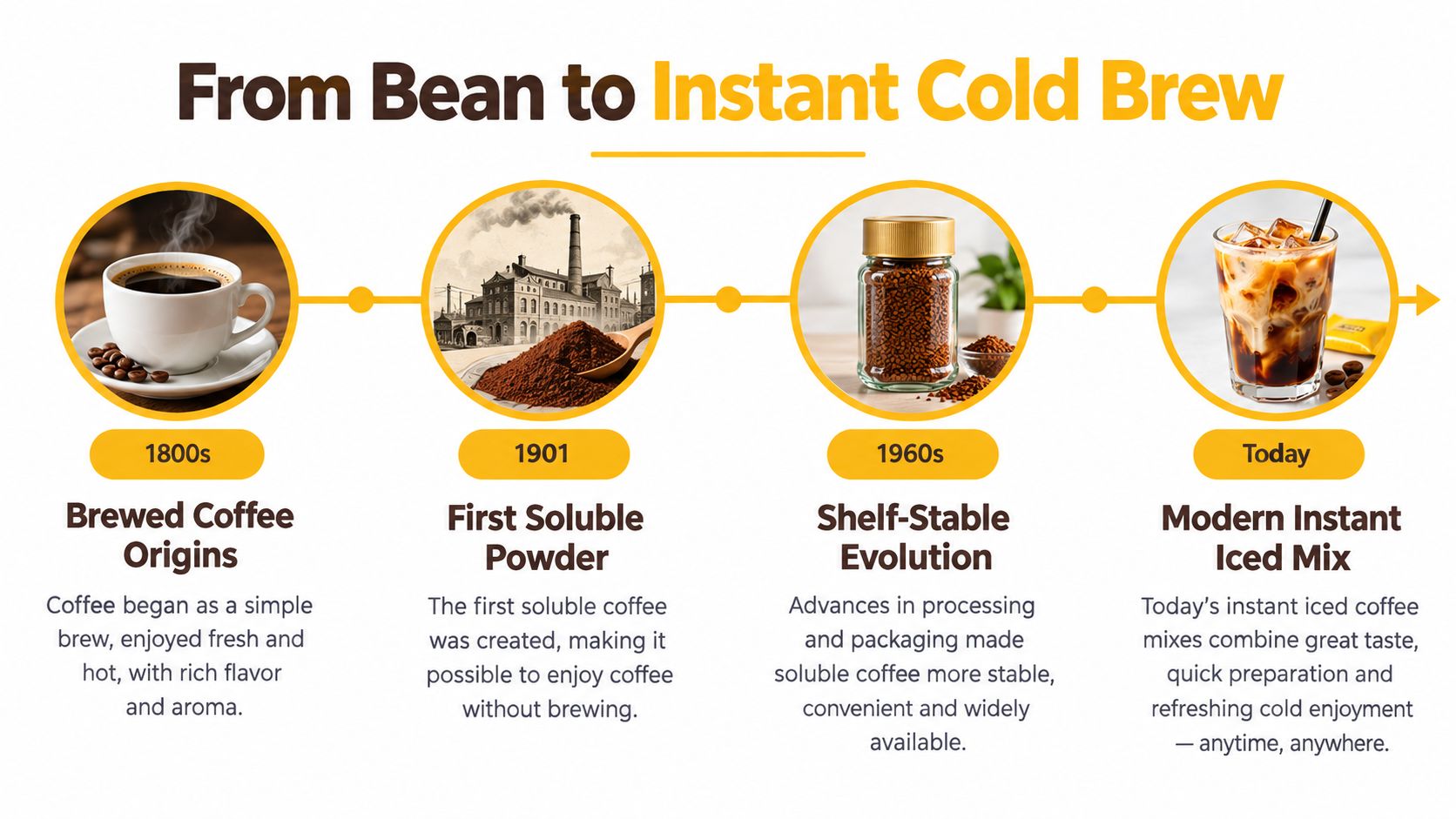
Instant coffee starts as brewed coffee. To make it soluble, producers turn coffee extract into a dry product that can be stored and later reconstituted with water. That transformation is what makes a cold instant drink possible: instead of extracting flavor from grounds at home, you dissolve coffee solids that have already been prepared during manufacturing.
In 1938, Nestlé introduced Nescafé in Switzerland after Dr. Max Morgenthaler developed a process that combined brewed coffee extract with soluble carbohydrates and used spray drying to create a shelf-stable powder. Large-scale production was established at the company's factory in Orbe, and the product launched in the United Kingdom two months later, as Nestlé's account of coffee manufacturing describes.
Two drying methods, different particles
Spray drying atomizes coffee extract into hot air, drying it into particles. Freeze drying freezes the extract, breaks it into granules, and removes ice under vacuum. Both methods produce soluble coffee, but the finished particles can differ in shape, size, and how readily they take up liquid.
Those differences help explain why one jar may sink and stir in smoothly while another leaves floating specks. It is not a question of "fine" versus "coarse." For cold preparation, the structure of the granules and how well water can move around them matter too.
From practical ration to everyday convenience
Instant coffee gained broad visibility through its inclusion in U.S. Army rations during World War II. Its appeal was practical: dry coffee could travel and be prepared without a full brewing setup. The same basic advantage still applies to a work bag, a hotel room, or a campsite.
The coffee's backstory is useful when reading product descriptions, but the central idea is simple: instant coffee is already soluble, yet different production methods can create particles that behave differently in cold liquid. For a more detailed explanation of the underlying process, see how instant coffee works.
Powder, Concentrate, or Ready to Drink
The easiest format to choose is the one that fits where you'll use it. Powder is a compact option for people who can access water and want to control how much they make. Liquid concentrate saves the dissolving step but asks you to carry a bottle. Ready-to-drink coffee is the simplest choice when you want to open and sip, but it's less adaptable.
| Format | Prep Time | Portability | Cost Per Serving | Best For |
|---|---|---|---|---|
| Powdered mix | Stir into water or milk; technique affects dissolution | Light and compact, especially in individual sachets | Depends on serving size and package | Travel, camping, desks, and adjustable drinks |
| Liquid concentrate | Dilute or mix with milk | Convenient, but the container adds bulk | Compare label serving size and bottle price | Home or office use where carrying a bottle is manageable |
| Ready to drink | Open and serve | Portable, though you're carrying the prepared drink | Compare package price with serving size | Convenience when you don't want to mix |
Powder for flexible portions
Powder is especially useful when packing space is tight or you want to make coffee only when you're ready. It also lets you adjust the amount of water, milk, and ice to suit your taste. But don't assume every product is a plain coffee powder: some mixes include ingredients that make the drink sweeter or creamier. Check the ingredient list if you want to control those additions yourself.
Concentrate when you'd rather skip the stirring
Liquid concentrate offers another shortcut. You measure it into water or milk instead of dissolving dry granules, which can feel convenient in a kitchen or office. The trade-off is carrying and storing a liquid container, and the bottle's size may matter more than the preparation time on a trip. If you're weighing this option, what coffee concentrate is can help clarify how it differs from soluble powder.
Ready-to-drink coffee wins on simplicity: open the package, and you're done. It's a sensible fallback for errands or a commute, but you can't adjust the base drink as freely as you can with powder. Compare the serving size and ingredients on the label rather than assuming one format is automatically cheaper or better.
Mixing It Right When the Water Is Already Cold
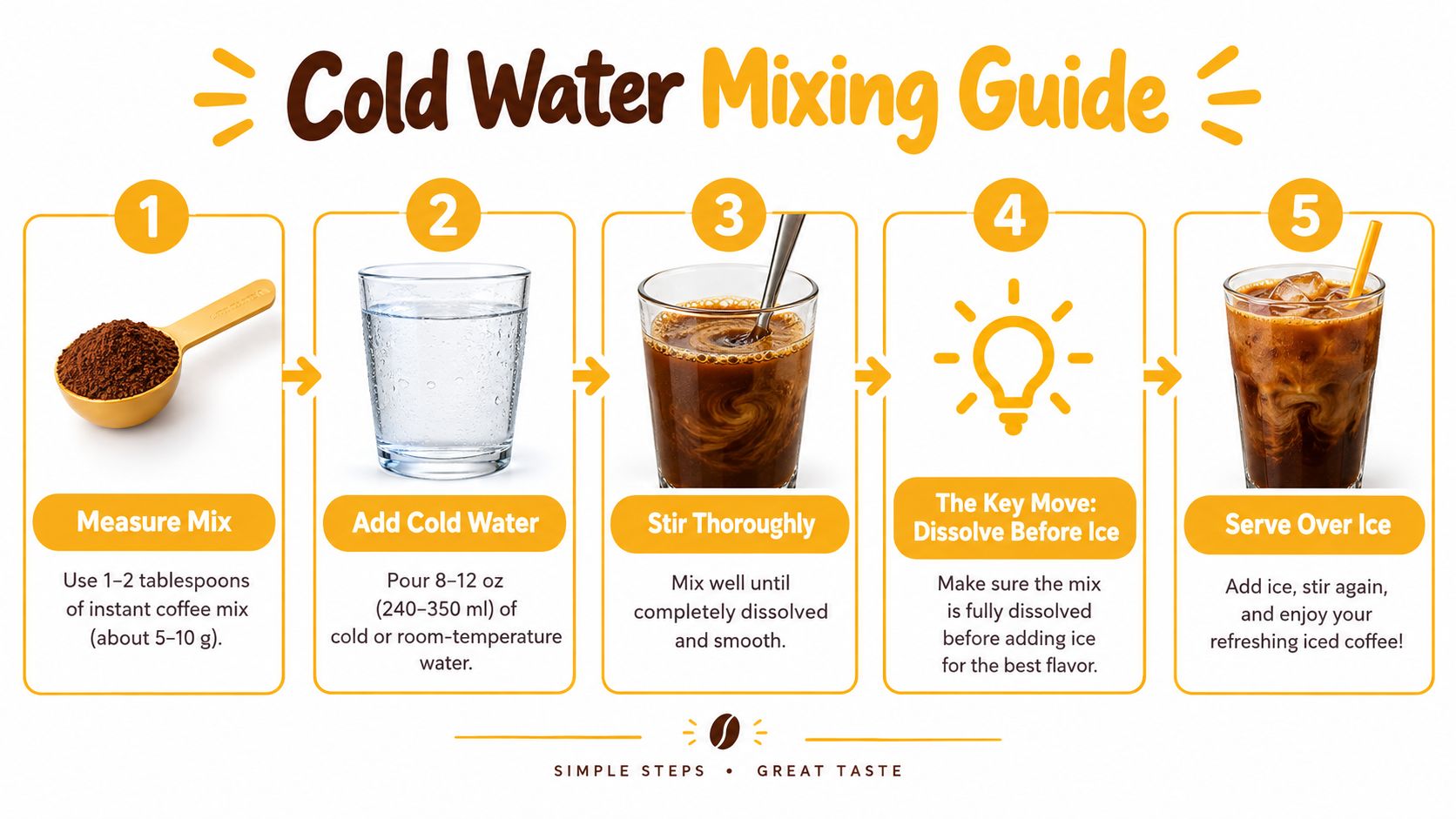
A smooth iced coffee starts before the ice goes in. When powder lands directly on ice or in very cold liquid, some granules may wet unevenly. Making a small concentrate first gives you a chance to break up the powder and check that it's dissolved before you dilute the drink.
Try the splash-first method
- Measure the mix. Follow the product's serving directions as your starting point, then adjust to taste.
- Add a splash of room-temperature water. Use enough to wet the powder and leave room to stir. Don't pour in the ice yet.
- Stir until smooth. Scrape the bottom and sides of the glass, where dry powder can hide.
- Add cold water or milk. Stir again, then taste before adding ice.
- Finish over ice. If the drink will sit for a while, start with a stronger concentrate so melting ice doesn't leave it tasting thin.
Particle structure also plays a role. Technical guidance reports that agglomerated soluble-coffee granules with limited fines tend to sink and dissolve in cold water more effectively than non-agglomerated powder. At about 16 °C, suitable agglomerated powder can dissolve with moderate stirring in about three minutes (technical guidance on soluble-coffee powder). That's a useful reminder that “instant” doesn't mean every powder will vanish in a swirl of ice-cold water.
A shaker bottle can help when you're away from a spoon, but dissolve the powder with some liquid before adding ice or filling the bottle to the brim. If you get grit, add a little more room-temperature water and stir or shake again. If the drink tastes weak, check whether ice has diluted it; if it's too strong, add liquid gradually instead of trying to correct it all at once.
Water's taste can affect the final cup, too. If your tap water has a noticeable flavor, this resource on getting consistent cold-beverage flavor with water filtration offers useful context. For a demonstration of the mixing approach, you can also watch this short video.
Travel, Camping, and the Science of Staying Fresh
Powder's travel advantage is obvious: you can pack a dry serving and add water when you arrive. Its weakness is less obvious. Soluble coffee is hygroscopic, meaning it absorbs moisture from the air. Once a package is opened, humid air can make powder sticky, encourage clumps, and interfere with how it pours and dissolves.
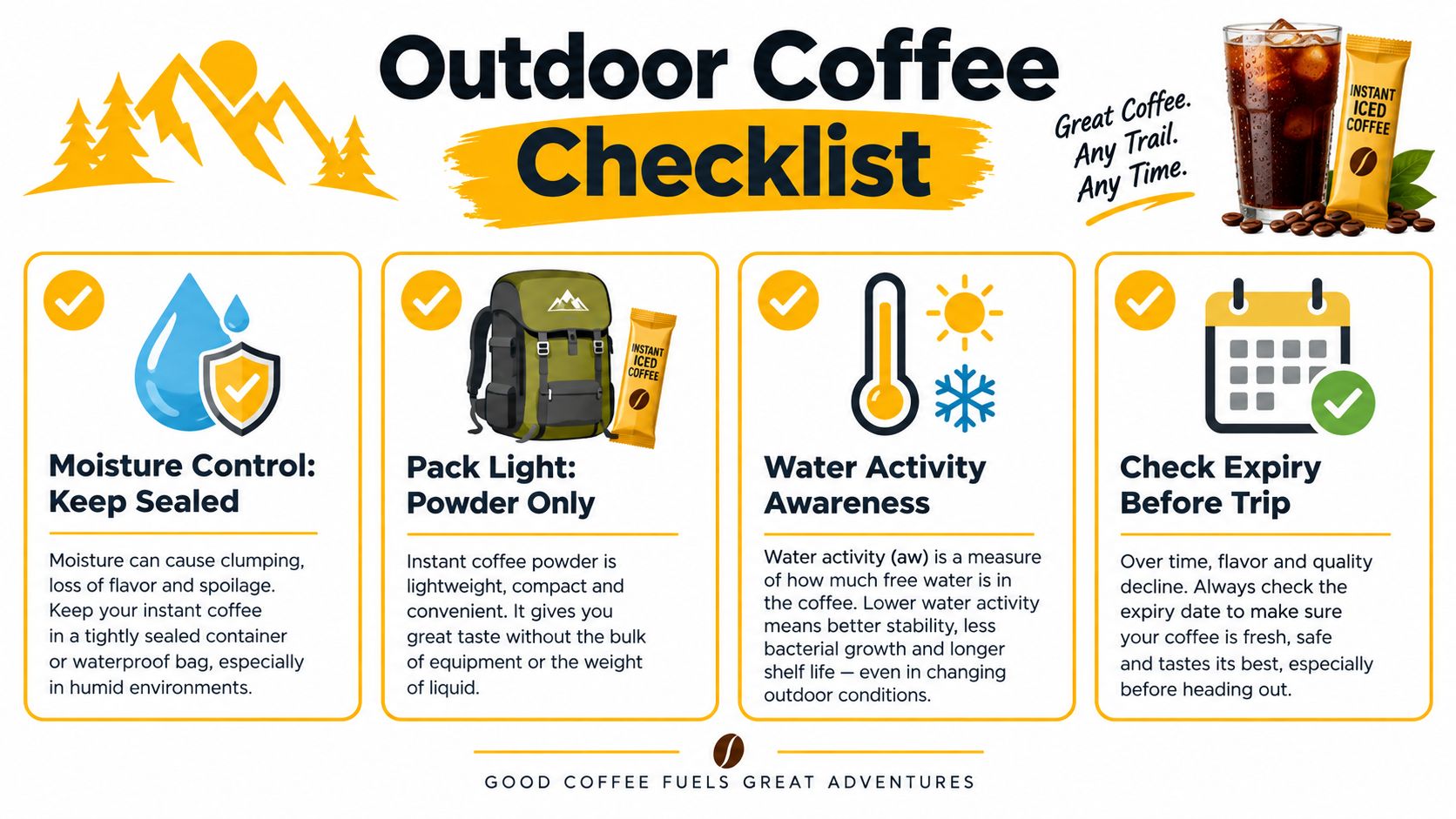
Water activity is a way of describing how available moisture is within a food, not just how much water it contains. In a study of commercial instant coffees, freeze-dried products had roughly 2.1–3.0% moisture and water activity of 0.202–0.326. Spray-dried products ranged around 2.3–4.0% moisture, and visible quality changes appeared around water activity 0.4–0.5 (commercial instant-coffee storage study). Those results show why keeping powder dry is part of keeping it usable, not just a matter of neat packing.
Pack for the conditions, not just the destination
For a short outing, a single-serve sachet keeps the unused coffee protected until you need it. For a longer trip, keep the main container tightly sealed and move only the portion you expect to use into a small dry pouch. Avoid leaving an open jar beside a damp tent entrance or repeatedly exposing it to humid air.
A well-sealed package with a reliable moisture barrier matters more than a vague claim about freshness. At home, a tightly closed jar can work well when stored in a dry cupboard. In a humid climate, single-serve packets are especially practical because each opening exposes only one dose. A desiccant pack may help if it's intended for the package, but it doesn't replace closing the container properly.
For a trip, protect the powder first and solve the cold-water mixing second. A dry sachet is easier to use than a jar that has absorbed moisture and formed sticky lumps.
Check the package's storage instructions and expiry date before packing it, and bring water you'd be happy to drink on its own. If you're planning camp meals as well as coffee, Just Cook It's grab-and-go breakfast options can offer ideas for food that travels easily. For coffee-specific packing considerations, see instant coffee for camping.
Matching the Mix to the Person Drinking It
The right mix depends on when and where you'll drink it, and on how much control you want over the final cup. An office worker might keep plain soluble coffee in a desk drawer and add milk at the counter. A parent may prefer a pre-portioned packet that makes a quick drink without setting up a brewer. A camper may put portability and sealed packaging ahead of a fussy preparation ritual.

If you enjoy adjusting sweetness and creaminess yourself, choose a mix with ingredients that suit that preference. A plain coffee powder gives you more control over milk, syrups, or sweetener. A premixed product can be convenient, but its included ingredients are part of every serving, so read the label rather than judging by flavor name alone.
Make room for routines beyond caffeine
Iced coffee can be a treat or a small part of a daily routine, not just a way to get caffeine. A 2025 DoorDash survey reported that 87% of respondents drank iced coffee even when they didn't need caffeine, 79% viewed it as a treat during overwhelming periods, and 86% said it boosted their mood (survey reporting on iced coffee habits). Those responses describe how people say they use the drink; they don't establish a clinical mood benefit.
If you're sensitive to caffeine or trying to reduce it later in the day, don't rely on the drink's name or apparent strength to judge your intake. Check the package for caffeine information, follow its serving guidance, and adjust the amount of mix rather than assuming that more ice means less caffeine. You can also choose a smaller serving or add milk and water to change the drink's size and taste, while remembering that dilution doesn't remove the caffeine already in the cup.
For enthusiasts who want a quick hotel-room option, a quality-focused instant coffee can be a useful compromise. Cartograph Coffee offers organic freeze-dried instant coffee in single-serve packets, including a plain option without sugar, flavors, or additives that can be prepared as iced coffee. That's one possible fit for someone who values portability and wants to customize the drink rather than carry a premixed beverage.
Putting It All Together for Your Next Cup
Start with the place you'll drink it. A jar may suit your kitchen, while sachets make more sense for a desk drawer, a backpack, or a trip where humidity and shared storage could be concerns. Choose a ready-to-drink coffee when the convenience of opening a package matters more than adjusting the recipe.
Then check the product itself. Look at the ingredients, serving directions, and any information the label provides about preparation and caffeine. If cold-water performance is your priority, favor clear guidance about dissolving the mix and test it in the liquid you plan to use.
Use the splash-first method before adding ice. It gives you a chance to dissolve the powder and taste the coffee before melting ice changes its strength. Once you've found a ratio you like, note it so your next cup doesn't depend on guesswork.
The broader coffee habits make this format worth considering: the National Coffee Association reported that 11% of past-day U.S. coffee drinkers consumed instant coffee in its latest cited survey, compared with 6% in 2021, while cold and iced coffee accounted for 31% of coffee consumed in a June survey, up from 23% in January of the same year (National Coffee Association coffee-consumption findings). These figures describe instant coffee and cold coffee separately, not instant iced coffee mix as its own category. For a small treat to pair with your glass, you can also find cold brew chocolate treats.
If you're looking for portable coffee that's easy to prepare at home, at work, or outdoors, explore Cartograph Coffee. Choose a format that fits your routine, then try the splash-first method to make your next iced cup smoother.