The big question of instant coffee vs regular really comes down to what you value more in that moment: convenience or experience. Think of regular coffee as the full sensory journey—the rich, complex aroma and taste you get from brewing freshly ground beans. It's a ritual for so many of us. Instant coffee, on the other hand, is all about speed and simplicity. You trade some of that sensory depth for pure, unadulterated efficiency.
The Quick Answer For Your Coffee Craving
So, which one should you reach for? The answer changes with your situation. If you're flying out the door on a Tuesday morning, instant coffee is your best friend. But if you’re easing into a slow weekend, nothing beats the process and reward of a freshly brewed cup. One isn't flat-out "better"—they just play different roles. At its heart, regular coffee is an agricultural gem celebrated for its nuance, while instant coffee is a feat of food science built for speed.
This core difference shapes everything. For true coffee aficionados, the rich, aromatic experience of brewing a pour-over or French press is non-negotiable. The whole process—weighing the beans, the whir of the grinder, that first bloom as hot water hits the grounds—is just as satisfying as the first sip.
But let's be realistic. Sometimes, practicality wins. Instant coffee requires zero equipment beyond a mug and hot water, leaves no messy grounds behind, and gives you that much-needed caffeine kick in under a minute. And let’s be clear: we're not talking about your grandma's instant coffee. Modern specialty instant coffee has come a long way, closing that quality gap and delivering a surprisingly satisfying cup.
To make the choice easier, let's break down how they compare side-by-side.
Instant Coffee Vs Regular Coffee At a Glance
This table summarizes the core differences between instant and regular coffee, helping you quickly identify which brew aligns with your lifestyle and preferences.
| Attribute | Instant Coffee | Regular Coffee (Brewed) |
|---|---|---|
| Preparation Time | ~30 seconds | 3-10 minutes |
| Flavor Complexity | Lower; often one-dimensional | Higher; nuanced and aromatic |
| Equipment Needed | Kettle or hot water source | Grinder, brewer, filters, etc. |
| Cost Per Cup | Generally lower | Varies; typically higher |
| Clean-Up | Minimal; no grounds | Requires cleaning brewer and disposing of grounds |
| Best For | Speed, travel, convenience | Flavor, ritual, customization |
As you can see, each one has a clear time and place. It’s all about matching the coffee to the moment.
From Bean to Cup: The Production Process Explained
The real story behind instant and regular coffee isn't just about what ends up in your cup; it’s about two completely different journeys from bean to brew. One is a familiar ritual of craftsmanship, while the other is a marvel of food science. Understanding how they're made is the key to knowing why they taste, smell, and feel so different.
The Journey of Regular Coffee
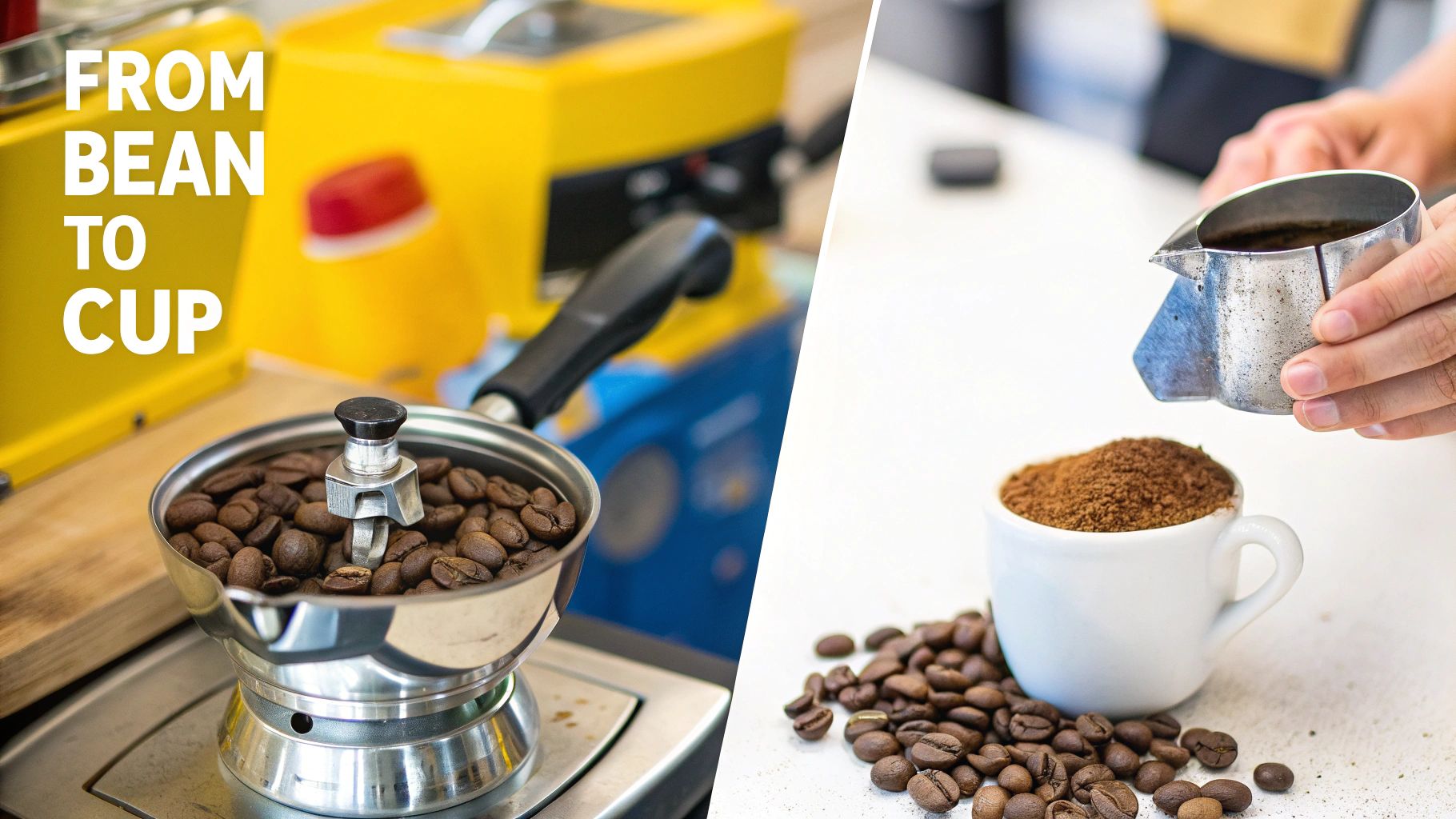
Regular coffee follows a path most coffee lovers can picture. It starts with carefully selected green coffee beans, which are then roasted to coax out their unique flavors. Once cooled, the beans are ground down into small particles.
Then comes the final, crucial step: brewing. Whether you’re using a French press, a pour-over dripper, or an espresso machine, you're using hot water to extract all the good stuff—oils, acids, and aromatic compounds—directly from the grounds. This direct-from-the-source extraction is what gives a freshly brewed cup its rich body and complex aroma. Every tiny adjustment, from the water temperature to how coarse the grind is, plays a role in what you ultimately taste.
The Science Behind Instant Coffee
Instant coffee also starts its life as brewed coffee, but on an enormous industrial scale. From there, the paths diverge completely. The goal isn't to pour it into a mug, but to remove all the water, leaving behind a stable powder that can be rehydrated later.
Key Insight: The entire instant coffee process hinges on one thing: water removal. The method used to dehydrate the coffee has the single biggest impact on the flavor and quality of the final product.
To get those familiar crystals, producers use one of two highly technical drying methods. The difference between them is night and day, which explains why some instant coffees taste so much better than others. For a deeper dive into the mechanics, check out our guide on how instant coffee works.
Spray-Drying
This is the old-school, high-speed, low-cost approach. The coffee concentrate is blasted as a fine mist into a tower of incredibly hot air, often around 480°F (250°C). The water evaporates in a flash, and what’s left is a fine coffee powder.
The downside? That intense heat is brutal on the coffee’s delicate flavor compounds. It essentially burns off the nuanced aromatics that make coffee so special, which is why many cheaper instant coffees have that famously flat, sometimes burnt, taste.
Freeze-Drying
Freeze-drying is the sophisticated, gentle alternative. It's a much more involved process, but the results speak for themselves:
- Freezing: The brewed coffee concentrate is flash-frozen to about -40°F (-40°C) until it’s a solid slab of coffee ice.
- Sublimation: This slab is then placed into a powerful vacuum. The low pressure causes the frozen water to turn directly into vapor, skipping the liquid phase entirely.
- Result: What remains are porous coffee granules that have kept their original oils and aromatic compounds almost perfectly intact.
By completely avoiding harsh heat, freeze-drying preserves the coffee's authentic character. This is the only method we use at Cartograph Coffee, because it produces a cup that is remarkably close to freshly brewed coffee. It closes the gap between convenience and quality, delivering a rich, aromatic experience that will change your mind about what instant coffee can be.
A Detailed Comparison of Your Daily Brew
Once the beans leave the roaster, the real story of the instant coffee vs. regular debate unfolds right there in your mug. The two paths diverge significantly, creating noticeable differences in taste, aroma, caffeine kick, and even nutritional profile. Getting to know these nuances is the key to understanding why you might reach for one over the other.
The most immediate and profound difference is sensory. A freshly brewed coffee is a celebration of complexity. As hot water hits the grounds, it's like a key unlocking hundreds of volatile aromatic compounds. These oils and acids are what create the rich, layered flavors and intoxicating smells we coffee lovers live for—from the bright, citrusy notes in a light roast to the deep, chocolatey tones of a dark one.
Instant coffee, on the other hand, has a much different journey. It's brewed, concentrated, and then dehydrated. While modern techniques like freeze-drying are surprisingly good at preserving flavor, some of the most delicate and volatile aromatic compounds just don't survive the trip. The result is often a flavor profile that's more straightforward and less nuanced.
Taste and Aroma: The Sensory Showdown
The incredible taste of a freshly brewed cup comes directly from its extraction. In that moment, the water pulls oils and soluble solids from the grounds, creating a coffee with a distinct body, acidity, and aroma. It’s why a pour-over tastes so different from a French press—the brewing method itself is an active participant in shaping the final flavor.
Instant coffee is essentially just rehydrated coffee. Since it was already extracted and dried long before it got to you, the sensory experience is more or less fixed. The goal is consistency, but that often comes at the cost of the dynamic, vibrant character you get from a fresh brew. Think of it like fresh-squeezed orange juice versus juice from concentrate. Both are orange juice, but one captures that just-picked brightness in a way the other can't quite replicate.
The Flavor Gap: Regular coffee’s flavor is born in the moment of brewing, releasing a symphony of aromas. Instant coffee’s flavor is a preserved memory of a previous brew, aiming to bring that experience back to life with just a splash of hot water.
Caffeine Content: Is There a Clear Winner?
It’s a common myth that regular coffee is always a caffeine powerhouse compared to its instant cousin. While a standard cup of brewed coffee usually has more caffeine, the difference isn't always as dramatic as you'd think, and there's a lot of variability at play.
- Regular Brewed Coffee: An 8-ounce cup typically lands somewhere between 70-140 mg of caffeine. That's a huge range because it all depends on the bean, the roast level, and how you brew it. A light roast drip will give you a different buzz than a dark roast French press.
- Instant Coffee: A typical 8-ounce cup, made with one teaspoon of granules, contains around 30-90 mg of caffeine. This range is also quite wide, as some brands use higher-caffeine Robusta beans to give their instant blends a little more punch.
But here’s the thing: you’re in the driver's seat. If you add an extra scoop to your Chemex or use a heaping teaspoon of instant crystals, you’re the one controlling the final caffeine dose. This flexibility means it’s easy to make a strong cup of instant or a milder cup of brewed coffee, blurring the lines between them.
Health and Nutrition: A Balanced View
From a wellness standpoint, both instant and regular coffee are on pretty equal footing. They both deliver a powerful punch of antioxidants, which are fantastic for fighting cellular damage caused by free radicals. In fact, for many people, coffee is the single biggest source of antioxidants in their diet.
Interestingly, while you might expect the processing to strip instant coffee of its goodness, studies show it retains a significant amount of antioxidants. In some cases, high-quality instant can even have higher concentrations of certain beneficial compounds because of how it’s made. Both types are rich in chlorogenic acids, which have been linked to a whole host of health benefits.
One topic that often comes up is acrylamide, a chemical that forms when coffee beans are roasted. Acrylamide is found in lots of cooked starchy foods, and it's a potential concern in very high amounts. Some research has shown that instant coffee can contain up to twice as much acrylamide as fresh-brewed coffee.
Before you panic, it's important to know that the levels in both are still well within what's considered safe for consumption. For the average person, the well-documented health benefits of drinking coffee—like a reduced risk for certain diseases—are generally thought to far outweigh the potential risks from acrylamide.
To help you see the differences side-by-side, here’s a quick breakdown.
Detailed Feature Showdown: Instant Vs. Regular
This table provides a granular comparison of specific attributes, offering both data and qualitative analysis to guide your decision-making process.
| Feature | Instant Coffee | Regular (Brewed) Coffee | Key Takeaway |
|---|---|---|---|
| Aroma Profile | Milder and less complex due to processing. | Rich and dynamic; hundreds of volatile compounds released during brewing. | Regular coffee offers a far superior aromatic experience. |
| Flavor Nuance | Generally more uniform and straightforward. | Complex, with distinct notes of fruit, chocolate, or nuts depending on origin and roast. | Choose regular coffee for a more sophisticated palate. |
| Caffeine (8 oz) | 30–90 mg; easily adjustable. | 70–140 mg; varies significantly with brew method and bean type. | Regular coffee is typically higher, but your preparation method is the biggest factor. |
| Antioxidants | Contains significant levels, sometimes concentrated during processing. | Very high in beneficial antioxidants like chlorogenic acids. | Both are excellent sources of antioxidants. |
| Acrylamide | Tends to have higher levels than brewed coffee. | Contains lower levels of this chemical. | Levels in both are considered safe for typical consumption. |
At the end of the day, choosing between instant and regular coffee is all about the trade-off. Brewed coffee is the undisputed champion of the sensory experience, offering unparalleled depth in both taste and aroma. But high-quality instant coffee, especially modern freeze-dried options, provides a remarkably convenient and genuinely enjoyable alternative. It delivers on the core promise of a satisfying cup without any of the fuss. Neither one is inherently "bad"—the best choice is simply the one that fits your priorities in that exact moment.
Looking at Cost and Environmental Footprint
Your daily coffee ritual has an impact that goes far beyond your morning jolt. It affects your wallet and the planet in very real ways. When you're weighing instant coffee against regular coffee, it’s tempting to just compare the price on the shelf. But the full story includes equipment, waste, and the energy used to get that coffee from the farm into your cup. Digging in reveals a surprisingly nuanced picture.
At first glance, a bag of specialty, single-origin beans looks pricier than a jar of instant. The real financial barrier to entry for brewed coffee, though, is the gear. Grinders, brewers, scales, filters... the costs can easily stack up to hundreds of dollars before you've even had your first sip. Instant coffee, on the other hand? All you need is a kettle and your favorite mug. The startup cost is practically zero.
The True Cost Per Cup
To get a real sense of the finances, you have to think in terms of cost-per-cup. That bag of premium coffee beans might seem like a splurge, but it makes a lot of coffee. The same is true for a jar of top-tier instant.
Let's break it down simply:
- Regular Coffee: The initial hit is high. You’re looking at a grinder ($50-$200), a brewing device like a pour-over or French press ($25-$70), and the ongoing expense of paper filters.
- Instant Coffee: Your only real cost is the coffee itself. This makes it an incredibly budget-friendly choice, especially if you're not ready to commit to a full brewing setup.
This accessibility is a huge part of its global appeal. In fact, instant coffee makes up over 34% of all retail brewed coffee consumed around the world, with sales hitting almost $31 billion last year. While coffee aficionados might lean toward premium brewed coffee, those numbers prove that for millions, instant is the practical powerhouse.
Unpacking the Environmental Impact
When we talk about the environmental footprint, we're really talking about two different kinds of waste. Neither method is perfect, but they pose different challenges—and offer different solutions. With regular coffee, the most obvious waste is the used grounds. Sure, they're biodegradable and fantastic for compost, but millions of tons still get tossed in the trash every year, where they release methane, a powerful greenhouse gas.
This is where instant coffee really stands out. It produces zero grounds waste at home. All the brewing happens at the factory, and the byproducts are often repurposed. Your morning cup leaves behind nothing but an empty mug.
A Clear Distinction: When it comes to the waste you produce at home, instant coffee has a definite advantage. It completely sidesteps the issue of disposing of coffee grounds, a major source of household food waste.
But that's not the whole story. The production side of things tells a different tale.
The industrial methods used to make instant coffee—spray-drying and freeze-drying—are energy-hungry. Freeze-drying, which does a better job of preserving flavor, is particularly intensive because of the energy needed for its freezing and vacuum stages. By comparison, the path regular coffee takes from the roaster to your grinder is less demanding on the production end.
Packaging is another piece of the puzzle. Instant coffee often comes in glass jars or tins, which are easy to recycle in most places. Regular coffee, however, is usually sold in flexible bags that are notoriously difficult to recycle.
Of course, sustainability is also about people. Choosing a brand committed to ethical sourcing means you’re supporting a healthier planet and better livelihoods for coffee farmers. If you want to dive deeper, you can learn more about what Fair Trade coffee means and see how it impacts communities and ecosystems. By keeping all these factors in mind, you can find a coffee that feels good for your budget and your conscience.
Choosing the Right Brew for Your Lifestyle
The whole instant versus regular coffee debate isn't about crowning one supreme champion. It’s really about finding the right coffee for the right moment. The best choice is simply the one that fits your priorities, your wallet, and your daily rhythm.
Let's be honest, what you need for a slow Sunday morning is a world away from what you grab on a chaotic Tuesday. Your lifestyle really calls the shots here, making the decision far more personal than technical.
The Commuter and Busy Professional
When your morning is a race against the clock, speed is the only thing that matters. The time-crunched commuter or busy professional needs a caffeine fix that's fast, consistent, and requires zero thought. In this arena, instant coffee wins by a landslide.
You just can't beat a 30-second prep time. The simple act of adding hot water, stirring, and walking out the door is a lifesaver when every second is precious. There's no brewer to clean and no messy grounds to deal with, making it the most efficient way to kickstart your day.
The Verdict: Instant coffee is the perfect sidekick for a fast-paced life. Keeping Cartograph Coffee’s single-serve packets in a desk drawer or travel bag means a great cup is always just a moment away.
The Weekend Coffee Connoisseur
Once the weekend hits and the pace slows, the ritual of making coffee becomes part of the reward. For the connoisseur, it’s not just about the caffeine—it's about the full sensory experience. They find joy in the process: the whir of the grinder, the aroma of the blooming grounds, and the complex flavors of a thoughtfully brewed cup.
This is where regular coffee truly comes alive. Brewing methods like a pour-over, French press, or AeroPress give you total control over every detail, from the coarseness of the grind to the exact temperature of the water. This hands-on approach unlocks the nuanced, aromatic profiles that high-quality, single-origin beans are known for—a depth instant coffee just can't fully match.
This flowchart can help simplify your choice based on what matters most to you, whether it's budget, environmental impact, or pure flavor.

As you can see, different priorities naturally lead you down different paths, showing exactly where each type of coffee excels.
The Adventurer and Traveler
For anyone who loves to camp, hike, or travel, every ounce of packed weight and inch of space matters. Dragging a grinder, brewer, and a bag of beans up a mountain just isn't practical. This is another scenario where the strengths of instant coffee are impossible to ignore.
It’s incredibly lightweight, compact, and needs no special equipment. All you need is hot water, which is easy enough to come by with a camp stove or a hotel kettle. It’s the ultimate travel companion, ensuring you can have a comforting, energizing cup no matter where your journey takes you.
The Budget-Conscious Student
When you’re watching every penny, cost becomes a huge decision-maker. Getting into regular coffee can mean a sizable upfront investment in equipment, not to mention the ongoing cost of good beans and filters. For a student or anyone on a tight budget, that can be a real hurdle.
Instant coffee, on the other hand, offers serious savings with a much lower cost per cup and almost no initial gear to buy. Its financial accessibility makes it a practical, smart way to keep a daily coffee habit without draining your bank account.
This practicality is reflected in coffee habits across the globe. While instant coffee makes up about 25% of all coffee consumed worldwide, its popularity swings wildly from place to place. In the U.S., it’s only about 4% of what people drink, but in the U.K. and Russia, that figure jumps to an incredible 70-80%. The Asia-Pacific region is a huge driver, accounting for 41.15% of global sales. You can dive deeper into these fascinating global coffee consumption trends to see how different cultures value convenience and cost.
In the end, the best coffee is the one that works for you. When you match your choice to your specific needs, you make sure every single cup is the right one for that moment.
How to Get the Best Taste From Any Coffee
Whether you're all about the ritual of brewing ground coffee or you live for the speed of instant, a few small tweaks can make a world of difference in your cup. The gap between a "meh" coffee and a truly great one often lies in these simple details. It proves that quality isn't just about the beans—it's about how you treat them.
No matter which camp you're in for the instant coffee vs regular debate, these tips will help you pull out the best possible flavor.
Elevating Your Instant Coffee
Even the quickest coffee deserves a little respect. To sidestep that classic bitter or scorched taste, never use boiling water. Seriously, this is the number one mistake. Let your kettle sit for about a minute after it boils, aiming for a temperature between 195-205°F (90-96°C). This slightly cooler water dissolves the granules gently instead of burning them, protecting the flavor.
Here's another trick I swear by: create a smooth base first. Mix your instant coffee granules with a splash of cold water and stir it into a thick paste before you add the hot water. This simple step ensures there are no clumps and gives your coffee a much richer, smoother texture.
By mastering a few key techniques, you can transform a quick cup into a quality experience. The rising popularity of specialty instant coffee proves that convenience no longer requires a compromise on taste.
Perfecting Your Brewed Coffee
For those who brew from grounds, getting a balanced, delicious extraction comes down to three non-negotiables. Nail these, and you'll unlock the full potential of your beans every time.
- Start with Fresh Beans: This is huge. Always buy fresh, whole beans and grind them right before you brew. Those wonderful aromatic oils start to disappear the second the beans are ground, which is why pre-ground coffee can taste so flat.
- Mind Your Water: Since your coffee is over 98% water, the quality makes a massive impact. Use filtered water if you can. It removes things like chlorine that can mess with the delicate flavors you paid for.
- Dial in Your Grind: Getting the grind size right is critical for your brew method. A coarse grind works for a French press; a fine grind is essential for espresso. Get this wrong, and you’ll end up with coffee that's either sour (under-extracted) or bitter (over-extracted).
At the end of the day, making better coffee is just about being a little more intentional. For a deeper dive into upgrading your quickest cup, check out our guide on how to make instant coffee taste better.
Still Have Questions About Instant vs. Regular Coffee?
Even after we've broken down the process, flavor, and cost, you might still be weighing your options. That's completely normal. Let's clear up some of the most common questions that pop up, so you can feel confident about what you’re brewing each morning.
Is Instant Coffee Actually Less Healthy?
Not really. Here’s the good news: both instant and regular coffee are loaded with beneficial antioxidants. While it's true that the intense heat used in some drying methods can reduce these compounds slightly, high-quality, freeze-dried instant coffee holds onto a remarkable amount of them.
The main point of debate is often acrylamide, a compound formed during roasting. Instant coffee tends to have slightly higher levels, but the amounts in both are well below the established safety guidelines.
The Bottom Line: For most people, the health differences are negligible. Both types of coffee offer far more antioxidant benefits than potential drawbacks, making either a perfectly fine choice for a healthy lifestyle.
Can Instant Coffee Ever Taste as Good as a Fresh Brew?
The old reputation for instant coffee being flat and bitter is, frankly, outdated. The game has changed completely. Premium, specialty instant coffees—especially those made with top-tier beans and a gentle freeze-drying process—get incredibly close to the taste of a freshly brewed cup.
Will it capture every single subtle, aromatic note of a pour-over? Maybe not. But it delivers a surprisingly rich, complex, and satisfying experience that will make you rethink everything you thought you knew about instant coffee.
Does Regular Coffee Always Pack a Bigger Caffeine Punch?
This is one of the biggest myths out there. While a typical 8-ounce cup of brewed coffee often contains more caffeine (70–140 mg) than a standard serving of instant (30–90 mg), you're in the driver's seat.
The final caffeine kick depends entirely on how much coffee you use. It's easy to make a strong cup of instant that has more caffeine than a weak cup of brewed coffee. The power is in your hands—and your spoon.
The global instant coffee market is on track to hit USD 21.9 billion by 2033, which shows just how much its quality and appeal are growing. This boom is driven by people like you who want convenience but refuse to settle for bad coffee. You can explore more market insights at imarcgroup.com.
Ready to taste the future of convenient, delicious coffee? Check out Cartograph Coffee's lineup of specialty instant coffees and see for yourself how incredible a quick cup can be. Find your new favorite brew at https://cartographcoffee.com.