You're standing in the kitchen before a busy day begins. The kettle is ready, the clock is moving, and you want coffee with more character than a rushed cup of ordinary instant. Cuban roast coffee seems to promise exactly that, a dark, fragrant drink with a deep aroma and a finish that lingers. Yet the name can be confusing. It may describe a roast style, a preparation tradition, a geographic origin, or a product inspired by Cuban coffee culture.
Understanding those distinctions makes the cup more rewarding. Cuban coffee connects agricultural history, migration, hospitality, careful roasting, and practical brewing. It can be prepared slowly in a moka pot, shared in small servings, or adapted for an office, campsite, or early morning when there's no time for elaborate equipment.
The Cuban Coffee Morning Ritual
Before the day gathers speed, a Cuban kitchen may already be in motion. A moka pot heats on the stove, small cups wait nearby, and the aroma of concentrated coffee reaches the room before the first conversation is complete. One person prepares the sweet, foamy topping while another offers a cup. The drink turns an ordinary morning into a shared pause.
The ritual gives coffee a social role. It is hospitality served in liquid form, offered to family, neighbors, visitors, and coworkers. Because the portions are small, drinking can be quick, yet the exchange around the cup may continue. In cafés and walk-up windows, sharing coffee creates a brief meeting place, even during a busy day.

A tradition shaped by place
The ritual carries the influence of centuries of cultivation, a history explored in detail in the section on Cuban coffee production. That background helps explain why the morning cup feels larger than its size. It reflects Caribbean exchange, migration, changing labor systems, and generations of knowledge about growing coffee in mountainous and agroforestry settings.
The sensory experience reinforces the ritual. A dark, fragrant brew arrives in a little cup, often balanced by sweetness and shared immediately. Its intensity invites attention, while the act of offering it signals welcome.
Cultural insight: The small cup is part of the experience. Cuban coffee is often made to be shared, not treated as a private beverage consumed without conversation.
Modern routines have changed the tools and timing. A parent may brew before school, a professional may prepare a serving at a desk, and a camper may carry an instant packet instead of a stovetop brewer. These options preserve the ritual's practical heart: concentrated coffee can fit a crowded schedule while still creating a moment of connection. Traditional preparation and modern instant coffee can serve the same purpose when the flavor, sweetness, and sharing remain central.
Understanding Cuban Roast Coffee Flavor Profile
Cuban roast coffee isn't a universally standardized technical category. The name usually signals a dark, forceful profile, but different roasters can use different targets. A useful definition should include measurable roast information, such as end-of-roast temperature, bean color, development time, and sensory results, rather than relying on the label alone. The scientific discussion of roast level and coffee composition supports that more precise approach.
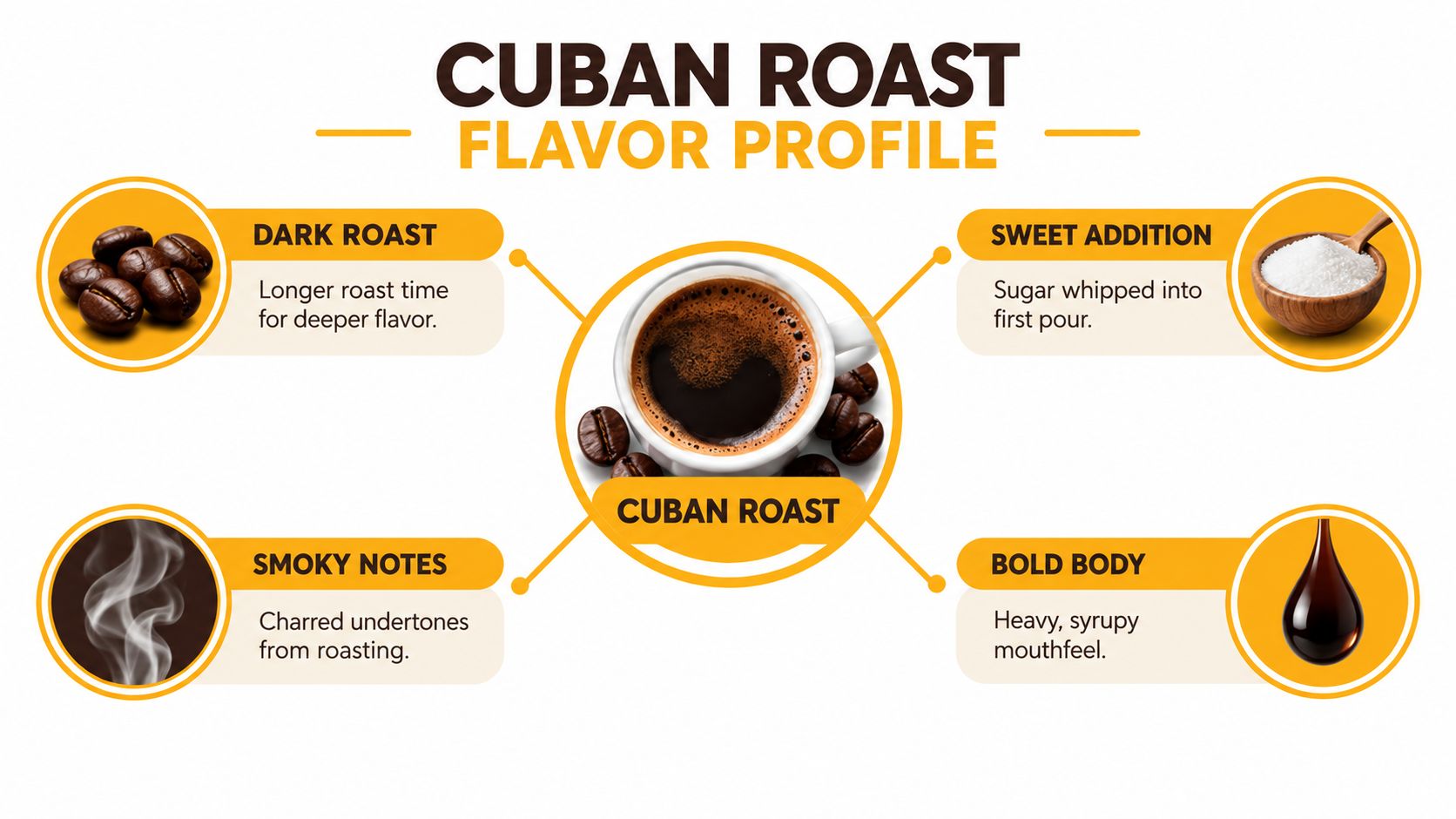
In the cup, the style commonly suggests low perceived acidity, pronounced bitterness, smoky depth, and a heavy body. Roasting changes the green bean's chemical structure. As roasting becomes darker, chlorogenic acids decline substantially, while changes in other organic acids can support sharper, bitter, or smoky sensations. Sugar-like aromas also shift toward caramelized, toasted, and sometimes charred impressions.
How to taste the difference
Start with aroma. A balanced dark roast should suggest toasted sugar, cocoa, spice, or roasted nuts before the first sip. If the aroma immediately resembles ash, the roast may have overwhelmed the bean's underlying character.
Then assess the body. Cuban-style coffee often feels dense and coating, particularly when prepared as a concentrated drink. The finish should be intense, but intensity alone doesn't guarantee quality. Bitterness can provide structure when sweetness and roast aromatics remain present. It becomes unpleasant when the cup tastes flat, acrid, or burnt.
Cuban roast also differs from the preparation itself. Café cubano refers to a sweetened coffee tradition, especially the foam created by whipping early brewed coffee with sugar. Cuban roast refers more broadly to the dark style associated with the flavor. A coffee can follow the roast style without being grown in Cuba, and a Cuban-grown coffee can be roasted in a lighter way.
For a practical comparison of roast behavior, see this guide to dark versus light roast coffee. It's useful to judge a product by its roast description, origin statement, ingredient list, and preparation instructions instead of assuming the word “Cuban” guarantees a single flavor.
A thoughtful product description should tell you whether the coffee is Cuban in origin, Cuban-inspired in roast style, or designed for café cubano preparation. That clarity helps you choose a cup that matches your expectations.
Historical Roots of Cuban Coffee Production
Cuban coffee grew from an exchange across the Caribbean. In 1748, Don José Gelabert planted coffee seeds brought from Haiti near Havana. From that beginning, cultivation spread through western regions, where mountainous terrain and shade-friendly farming supported the crop. Coffee became more than an agricultural product. It also became part of regional identity and daily life.
Production expanded sharply during the nineteenth century. Historical records describe growth from approximately 84.1 tonnes in 1790 to 29,163.1 tonnes in 1833, an increase of roughly 347 times in 43 years, according to this historical analysis of Cuban coffee production. Those figures place Cuban coffee within a substantial industry shaped by cultivation, trade, and public support, rather than a recent marketing label.
Expansion, support, and disruption
Government policy also influenced the industry. In 1927, the Cuban government created an Office of Coffee and Cocoa within the Agriculture Ministry, supported regional experiments with coffee varieties, and established the Cuban Institute for Coffee Stabilization. These measures linked farming with national agricultural policy and helped direct coffee production over time.
The twentieth century brought a sharp reversal. Cuba reached a modern production peak of approximately 60,326 tonnes in 1961, but production had fallen to 4,973 tonnes by 2012, about 91.8% below that peak, according to this production record and analysis. Harvested coffee land also declined from roughly 170,000 hectares in 1961 to 28,000 hectares in 2013, a decrease of about 83.5%, according to the same source.
A coffee tradition can therefore carry two stories at once: continuity and disruption. Cuban coffee reflects scarcity, economic change, agricultural policy, and adaptation, as well as the pleasures of a strong cup. That history helps explain why “Cuban roast” can suggest heritage as much as a particular flavor.
A useful distinction: A coffee can honor Cuban roast tradition without containing beans grown in Cuba. Check the stated origin, roasting location, and preparation style separately.
For busy drinkers, this distinction offers a practical choice. Authentic Cuban-grown beans may be difficult to find, while Cuban-style coffees can recreate a dark, concentrated profile with beans from other origins. Instant versions extend that tradition into modern routines, offering a quick way to approach the style without claiming the same agricultural origin. Clear labeling respects both the history and the person choosing the coffee.
Traditional Café Cubano Preparation Methods
The defining detail of café cubano is the espumita, a sweet, caramel-colored foam made from sugar and the first drops of brewed coffee. The method is simple, but timing matters. The early extraction contains concentrated coffee oils and flavor, which combine with vigorously stirred sugar to create a texture that ordinary sweetening doesn't reproduce.
The moka pot method
A moka pot remains the most accessible traditional tool. Use a grind that's finer than drip coffee but not as fine as a typical espresso grind. Fill the lower chamber with water below the pressure valve, place the grounds in the basket without tamping, and assemble the pot securely.
As the coffee begins to emerge, collect a small amount of the first liquid in a cup containing sugar. Stir briskly until the mixture becomes pale, glossy, and foamy. Let the moka pot finish, then pour the brewed coffee over the foam and serve promptly.
For a clearer explanation of the brewer's mechanics, read how a moka pot works. Understanding pressure and water flow makes troubleshooting easier. A bitter cup may result from excessive heat or an overly fine grind, while a thin cup may need fresher coffee or a more suitable dose.
Other ways to prepare it
An espresso machine can produce a concentrated base, although the workflow differs from a moka pot. You can also use a small stovetop brewer or another concentrated method, then prepare the sugar foam separately. A French press creates a flavorful coffee but not the same concentrated extraction, so it's better described as a Cuban-style sweetened coffee rather than a classic café cubano.
A small Greek coffee brewer can offer another compact stovetop option. If you're curious about the technique and equipment, this guide to brewing with a traditional briki provides useful context, though the resulting drink follows a different preparation tradition.
| Method | Equipment Needed | Best For | Authenticity Level |
|---|---|---|---|
| Moka pot | Moka pot, ground coffee, sugar, small cup | Traditional home preparation | High |
| Espresso machine | Espresso machine, grinder, sugar, small cup | Fast concentrated brewing | High for the coffee base |
| French press | French press, coarse grounds, sugar | Simple, less concentrated coffee | Moderate |
| Instant coffee | Instant Cuban-style coffee, hot water, sugar | Office, travel, camping | Style-inspired |
Avoiding common mistakes
Don't tamp moka pot grounds. Compacted coffee can restrict flow and create uneven extraction. Don't add all the sugar after brewing if you want espumita, because the foam depends on whipping sugar with the first coffee drops.
If the foam stays thin, use a little more vigorous stirring and capture the earliest liquid. If the coffee tastes harsh, lower the heat and stop brewing before the pot sputters aggressively. The best result balances concentration with sweetness, rather than chasing maximum bitterness.
Instant Coffee Solutions for Cuban Roast Flavor
A busy morning doesn't always allow time to fill a filter basket, monitor extraction, and whip espumita. Instant Cuban-style coffee offers a practical alternative for offices, travel, family kitchens, and campsites. It won't duplicate every detail of moka pot coffee, but a well-made product can deliver the key sensory cues, including deep roast aroma, dark color, bitterness, and a substantial finish.

What to evaluate on the label
Start with the ingredient list. Pure instant coffee should identify coffee as the central ingredient, while flavored or sweetened mixes should state added sugar, milk ingredients, or flavorings. Then consider the roast description. Terms such as dark, espresso-style, smoky, or bold can help, but they're most useful when paired with clear preparation guidance.
Solubility matters, especially when you're working with cold weather, limited water, or a shared kitchen. A good powder should dissolve evenly without leaving a gritty layer. Aroma matters too. Open the container and look for roasted sweetness and cocoa-like depth, not only burnt notes.
The visual experience influences expectations, but the cup still needs balance. Try a small amount first, then adjust the powder-to-water ratio. Too much water can flatten a dark roast, while too little can make it aggressively bitter.
After tasting the coffee on its own, you can explore making espresso-style coffee from instant coffee for ideas on building a more concentrated drink. For active lifestyles, a coffee-based shake can also work as a portable option. These coffee shake tips from Gym Snack offer practical ways to combine coffee with a cold, filling beverage.
Making instant coffee feel more traditional
To approximate the café cubano experience, dissolve the powder in a small amount of hot water first. Stir sugar into that concentrated mixture, then add the remaining water. For a foam-like top, whisk a little of the concentrated coffee and sugar before adding the rest.
This method changes the texture, not the product's origin or processing. It's best described as an instant interpretation of the ritual. That honesty matters. Convenience can preserve the flavor profile and the pause around the cup, even when it can't reproduce every detail of freshly brewed coffee.
Common Myths About Cuban Roast Coffee
Myth one: darker roast always means more caffeine. Roast darkness mainly changes flavor. A dark coffee can taste stronger because roasting emphasizes bitterness, smoke, and roasted aromatics, but that sensation doesn't reliably measure caffeine.
A 2024 study in Scientific Reports found that, under identical brewing conditions, dark roasts generally produced lower caffeine concentrations than light or medium roasts. At matched extraction yields, however, dark roasts generally produced higher concentrations, and the researchers concluded that extraction yield had a greater overall effect than roast degree alone, as described in this study of roast degree and brewed caffeine.
Grind size, dose, water temperature, brewing time, and serving size can all affect the final cup. If caffeine matters to you, compare preparation methods and serving information rather than assuming a dark label provides a predictable result.
Myth two: Cuban roast is automatically unhealthy. Dark roasting reduces chlorogenic acids and changes other compounds, but that fact alone doesn't establish that dark coffee is harmful. Health effects depend on the whole context, including quantity, individual tolerance, added sugar, and the way the coffee is prepared.
Myth three: “Cuban” always describes bean origin. Often, it describes a roast profile or a coffee designed for café cubano. Look for separate statements about bean origin, roasting location, roast level, processing, and ingredients. A transparent package doesn't need to blur those distinctions to create an appealing product.
Myth four: a smoky cup is automatically authentic. Smoke can be part of a dark roast profile, but excessive char can hide sweetness and origin character. Authenticity comes from the relationship between flavor, preparation, cultural context, and honest labeling, not from bitterness alone.
Cartograph Coffee offers organic instant coffee built for people who want richer flavor without giving up convenience, whether they're working, traveling, camping, or making a quick cup at home. Visit Cartograph Coffee to explore an instant approach to bold coffee that respects the tradition while fitting modern routines.